
About the author
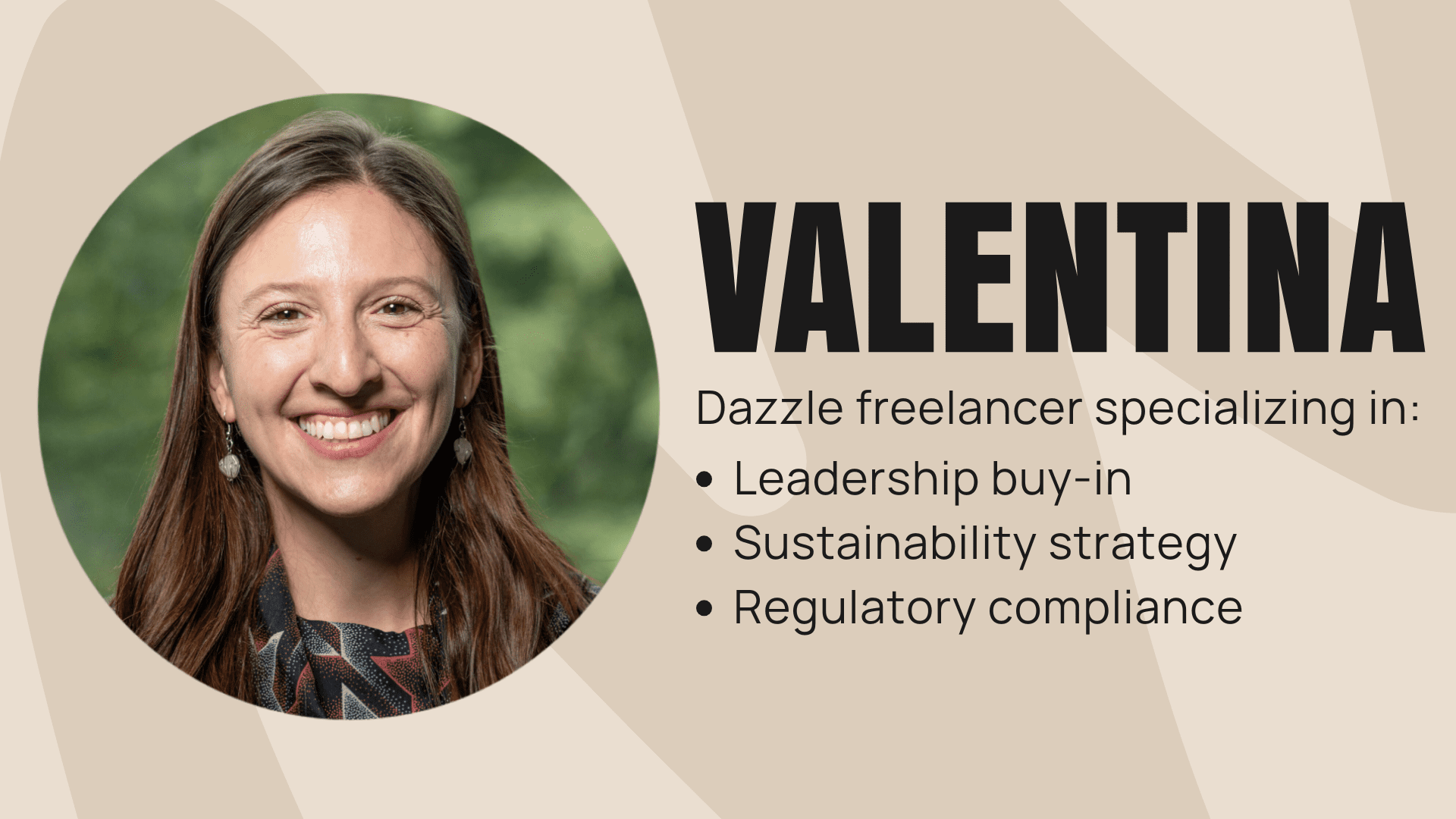
Valentina Baiamonte is a sustainability strategist with over 12 years of experience supporting companies and multi-stakeholder initiatives in integrating sustainability into business strategy, governance, and decision-making.
Her work focuses on moving organizations beyond CSR and compliance-driven ESG, towards business model transformation, risk management, and long-term resilience. Particularly in agriculture, food systems, and global value chains.
She has previously worked with international organizations and industry platforms, including the World Business Council for Sustainable Development.
She holds a PhD in International Relations and regularly advises and trains organizations on translating sustainability commitments into operational and strategic outcomes.
lf you feel you could use Valentina’s expertise, contact Dazzle today, and we will put you in touch with her within 48 hours.
You know the situation: you’ve put together a game-changing sustainability plan that you know will transform your organization for the better, but the board just doesn’t seem to get it?
Believe me, I feel your pain, because I know from experience: you’re definitely not the only sustainability professional struggling with this. Many teams seem to face resistance, usually because priorities aren’t clearly defined, initiatives aren’t tied to strategy, or the value case isn’t communicated in terms that leaders recognize.
And the thing is, leadership buy-in itself is often the turning point between sustainability ambitions and real business transformation.
That’s why I’ve put together these five expert tips, to help you approach leadership engagement with confidence, and ultimately, help you get your board on board with your transformative ideas!
1. Be clear on where sustainability sits in your organization

Clarify the distinction between CSR, ESG, business transformation, and systemic sustainability.
CSR often focuses on philanthropy and external initiatives, typically disconnected from core business strategy. ESG is driven by investor expectations and compliance, emphasizing metrics and reporting. Business transformation integrates sustainability into the business model, influencing value creation and decision-making. Systemic sustainability goes further, embedding long-term resilience and risk management into core operations.
Confusion between these levels can hinder leadership buy-in and cause initiatives to stall at the pilot stage.
2. Link sustainability to the right strategic objectives

Sustainability initiatives gain traction when they are directly connected to strategic objectives such as value creation, risk management, operational performance, or long-term resilience.
CSR activities are rarely strategic, while ESG often addresses compliance. For true buy-in, sustainability must be explicitly tied to business priorities and decision-making processes, ensuring alignment and realistic expectations between sustainability teams and leadership.
3. Speak the language of leadership and anticipate pushbacks

Frame sustainability proposals in business-relevant terms, focusing on priorities, trade-offs, risks, costs, and timing.
Anticipate concerns about complexity, accountability, ROI, and organizational impact. Addressing these issues upfront builds credibility and trust with leadership.
4. Start small and demonstrate quick wins

Select projects that are manageable and likely to deliver clear operational, financial, or risk-related benefits.
Early successes help demonstrate value, build internal momentum, and create the foundation for more ambitious sustainability initiatives over time.
5. Build the business case with evidence and meaningful metrics

Use benchmarking to show what peers and competitors are doing and highlight the risks of inaction.
Go beyond external reporting frameworks by developing metrics that resonate with internal stakeholders, such as efficiency gains, supply chain risk reduction, talent attraction, or brand value. This approach strengthens the business case and supports informed decision-making.
Making the value clear

Engaging leadership effectively means making sustainability clear, relevant, and strategically aligned. When leaders clearly understand both the risks and opportunities involved, they no longer see initiatives as abstract ideas, and instead see them as concrete actions that create measurable business value.
This clarity then helps to build alignment, momentum, and lasting impact across the organization.
The tips above give you a practical framework to achieve this. By positioning sustainability clearly within your organization, linking initiatives to core objectives, and backing proposals with evidence, you can approach leadership confidently, and increase the likelihood that your ideas will be embraced and acted upon.
An outcome that we both already know, will be of benefit to everyone involved.