
About the author
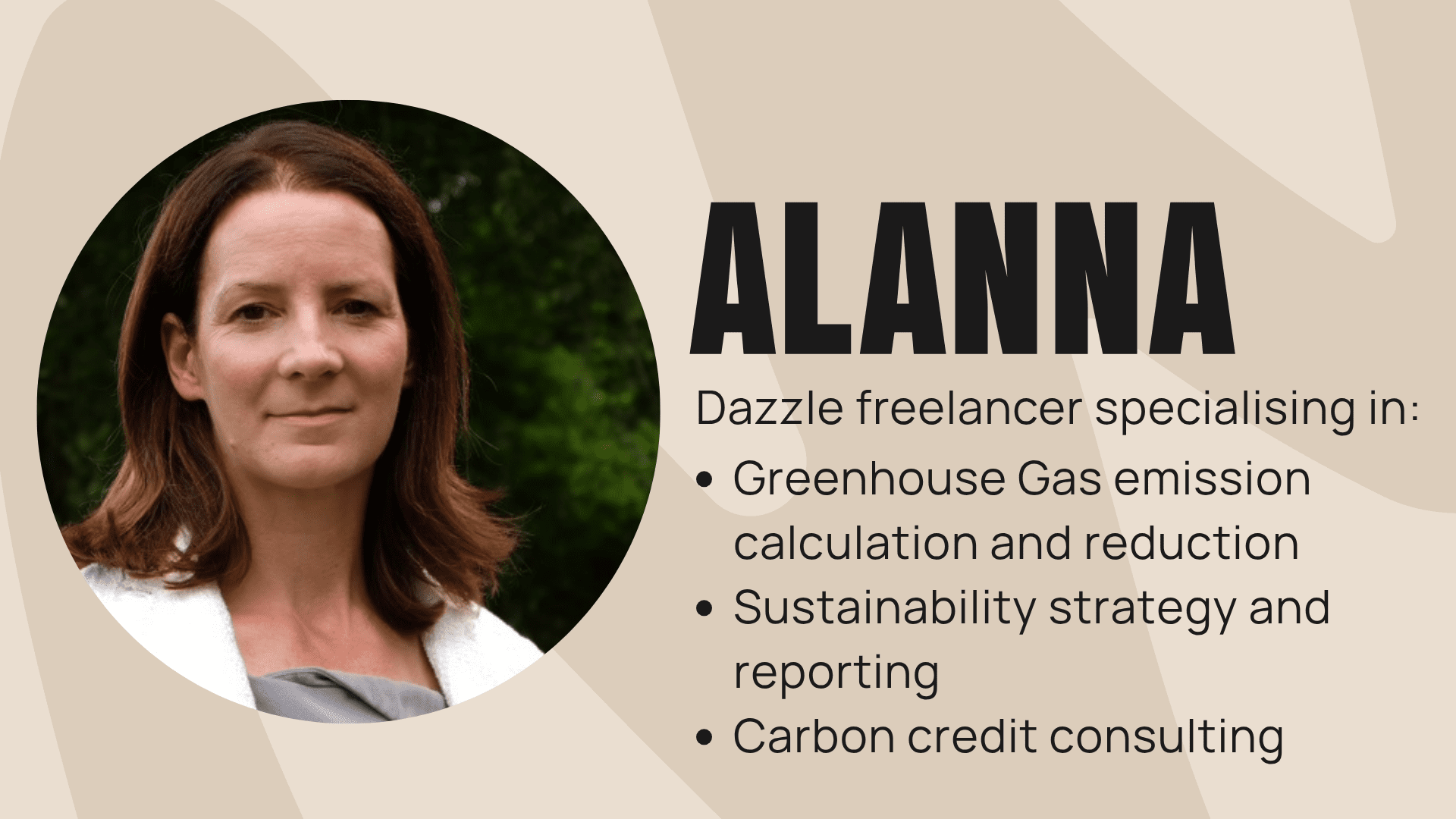
Alanna Loder-Symonds is a sustainability specialist and Agile Project Manager, providing practical, commercially grounded sustainability consulting and ESG reporting, turning sustainability from a compliance burden to a source of cost savings, risk reduction and commercial credibility.
She has 15 years’ experience advancing impactful environmental initiatives in banks, renewable energy firms, carbon credit startups and fintech. Alanna is a graduate of the University of Cambridge Institute for Sustainability Leadership’s Business Sustainability Management course.
Her specialisms include greenhouse gas emission calculation and reduction, sustainability strategy and reporting, sustainable funding advice, renewable energy expertise and carbon credit consulting.
If you feel you could use Alanna’s expertise, contact Dazzle today, and we will put you in touch with her within 48 hours.
As organisations accelerate their push toward net zero, one challenge is emerging as both unavoidable and deeply complex: Scope 3 emissions, the indirect greenhouse gas emissions generated across an organisation’s value chain.
The scale of the issue is hard to ignore. Scope 3 emissions typically account for around 70–95% of an organisation’s total footprint. In some cases, the concentration is even higher. Companies like Microsoft report that over 96% of their emissions sit in Scope 3, driven largely by supply chains and product use.
Around 48% of large-cap firms now measure Scope 3 emissions¹. Yet far fewer have worked out how to manage them in a way that drives real change.
The difficulty is not a lack of frameworks or ambition. It is that Scope 3 sits largely outside direct control. Expectations have also increased rapidly. Investors, regulators and customers are no longer satisfied with partial disclosures. They expect credible, value chain-wide strategies.
In this context, Scope 3 is no longer a reporting exercise. It is a test of how well sustainability is embedded into the way a business operates.
So how should organisations approach measuring and reducing Scope 3 emissions in 2026?

1. Treat Scope 3 as business-critical, not a reporting add-on
Investors, regulators and customers are putting pressure on companies to decarbonise. The first shift is mindset. Scope 3 is not an extension of Scope 1 and 2 reporting. It reflects core business decisions, from who you buy from to how your products are designed, delivered and retired. What was once considered an optional disclosure is rapidly becoming a core expectation under frameworks such as CSRD and ISSB.
Organisations that continue to treat Scope 3 as a compliance requirement will struggle to make progress. Those that recognise it as central to performance and competitiveness are far better positioned to act. This means elevating Scope 3 discussions beyond sustainability teams and into executive decision-making and yearly performance goals.
2. Focus on what matters most

One of the most common mistakes is trying to measure all fifteen Scope 3 categories with equal precision from the outset. In reality, emissions are highly concentrated.
A small number of categories typically account for most of the impact. For many organisations, purchased goods and services, capital goods and transport dominate the footprint. A more effective approach is to start with a high-level assessment, identify emissions hotspots and focus effort where it will have the greatest impact.
This allows organisations to move quickly from analysis to action, rather than getting stuck in unnecessary complexity.
3. Build a data strategy that evolves over time

Scope 3 is fundamentally a data challenge, but it is unrealistic to expect perfect data from the start. In fact, only around 7% of companies currently measure emissions comprehensively across all scopes according to Boston Consulting Group, highlighting the scale of the data gap.
The key is to have a clear plan for how data quality will improve. This includes aligning with existing systems such as procurement and finance, defining data sources early and avoiding duplication of effort.
Importantly, organisations should expect their numbers to change as data improves. This is not a failure. It is a sign that understanding is deepening and decision-making is becoming more informed.
4. Engage suppliers as partners, not data providers

Scope 3 is ultimately about influence. Progress depends on the ability to work with suppliers, not simply request information from them.
This is also where many organisations encounter their biggest barrier. Research consistently highlights lack of control over suppliers as the primary challenge in reducing Scope 3 emissions.
Many organisations approach this in a way that creates friction, sending complex questionnaires and expecting immediate, detailed responses. A more effective approach is to start with simple questionnaires, prioritise key suppliers and provide clear guidance on what is required and why.
Over time, this builds stronger relationships, improves data quality and creates opportunities for collaborative decarbonisation. Supplier engagement should be seen as a long-term process, not a one-off exercise.
Forward-thinking suppliers are increasingly recognising this dynamic and building it into their value proposition. UK battery technology company EQONIC, for example, has developed lithium and rare earth-free battery chemistry specifically using materials that are sustainably sourced and widely available, meaning manufacturers that switch to their technology can materially reduce the Scope 3 footprint associated with battery procurement, without sacrificing performance or cost competitiveness.
5. Connect emissions data to real decisions

The most important shift is moving from measurement to action. Emissions data becomes valuable when it informs decisions about procurement, design, logistics and investment.
Understanding where emissions sit in the value chain allows organisations to prioritise interventions. It can influence which materials are selected, which suppliers are preferred and how products are developed. It can also shape investment decisions by highlighting where change will deliver both financial and environmental value.
For example, a detailed value chain analysis might reveal that a significant share of Scope 3 emissions sits within a single category, such as capital goods procurement, creating a clear and immediate priority for action.
6. Accept that influence, not control, defines success

Scope 3 requires organisations to operate beyond their direct boundaries. Unlike Scope 1 and 2, emissions cannot be reduced through internal action alone. Progress depends on influencing behaviours across the value chain.
This introduces complexity and uncertainty, but it also creates the potential for far greater impact. Organisations that succeed are those that embrace this shift, building the capability to influence suppliers, partners and customers over time.
Conclusion
Scope 3 represents a turning point for sustainability.
Measuring emissions is no longer enough. The challenge now is to influence them at scale, across systems that organisations do not fully control.
For most organisations, Scope 3 accounts for most emissions, making it the single biggest barrier to achieving net zero. At the same time, it is the area where data is weakest, control is lowest and expectations are rising fastest.
Those that approach Scope 3 strategically, focusing on materiality, building strong data foundations and embedding emissions into decision-making, will not only meet expectations but gain a competitive advantage.
In 2026, Scope 3 is where sustainability moves from reporting to real-world impact.
¹ Mishra, S., “Current Trends in Scope 3 Disclosure Rates,” Harvard Law School Forum on Corporate Governance, October 2025. Read the full article
Need help getting started with Scope 3? Dazzle connects organisations with independent sustainability specialists, like Alanna, who can help you move from measurement to strategy. Get in touch to find the right expert for your challenge, or read how we work with a Scope 3 consultant.