
About the author
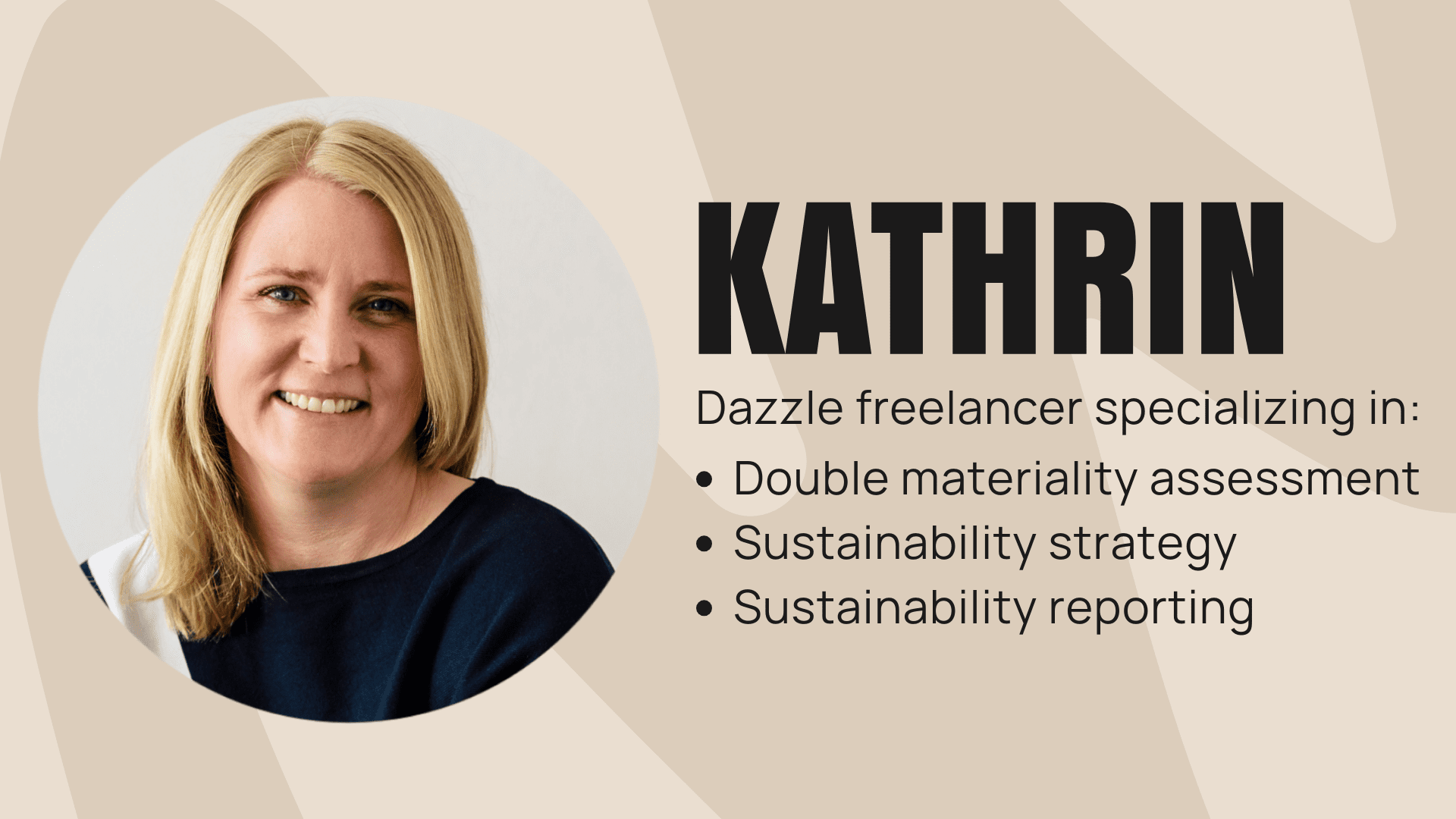
Kathrin Jansen helps companies integrate sustainability into their core strategy.
With her extensive knowledge of regulatory frameworks such as CSRD and ESRS, she advises companies on conducting robust double materiality assessments and translating complex requirements into practical processes and decisions.
She identifies the sustainability impacts, risks, and opportunities that matter most to a business and integrates them into strategy, governance, and risk management. She works with large corporations and mid-sized companies, which are often affected as suppliers, as well as NGOs and public sector institutions.
Based in Hamburg, Germany, Kathrin has several years of international experience, including time working with global corporations in the United States.
lf you feel you could use Kathrin’s expertise, contact Dazzle today, and we will put you in touch with her within 48 hours.
If you’re currently working on a double materiality assessment, chances are you’ve already run into a few challenges. Where do you even start? How do you avoid getting lost in the complexity of the ESRS? And how do you make sure the process actually delivers value, rather than becoming a box-ticking exercise?
You’re not alone in this. Many sustainability teams find that while the concept of double materiality is clear in theory, applying it in practice is a different story. The process can quickly become overwhelming, especially when key fundamentals about the business, value chain, or scope aren’t fully aligned from the outset.
The good news is that a strong double materiality assessment doesn’t have to be overly complicated. In fact, a few practical principles can make a significant difference, not just in simplifying the process, but in ensuring it leads to meaningful insights for the business.
These four tips below should help you cut through the complexity, and conduct a double materiality assessment that delivers real value for your company.
1. Begin with the company, not the reporting standard.

A robust double materiality assessment begins with a clear understanding of the company itself, including its business model, consolidation perimeter, value chain, and key raw materials and suppliers. This may sound obvious. In practice, however, many teams realize that fundamental questions are not always clear.
For example, which subsidiaries are in scope? Where do key inputs come from? Which parts of the value chain does the company own, and which are outsourced?
Clarifying these basics early on helps identify where sustainability impacts and risks arise, and prevents teams from getting lost in the reporting standard’s mechanics.
2. Use a top-down approach to reduce complexity

The revised ESRS framework allows companies to narrow down the list of potential topics at an early stage of the process.
A thorough context analysis (see tip 1), can help to eliminate clearly irrelevant topics before moving on to the detailed analysis of impacts, risks and opportunities.
When conducted effectively, this significantly reduces complexity and ensures the assessment remains focused.
3. The real value of a DMA lies in internal dialogue

A DMA that is managed well brings together colleagues from different departments to discuss the sustainability impacts, risks, and opportunities linked to the business.
These discussions can provide valuable insights into the company’s value chain, dependencies, and emerging risks.
Therefore, the process itself can be just as valuable as the final list of material topics. (This is why generating a DMA with an AI tool will rarely deliver optimal value, as this vital organizational learning will be missed).
4. Documentation is as important as the analysis

A credible DMA requires transparent documentation of assumptions, thresholds, scoring logic, and decisions. This is essential not only for audit readiness, but also for internal understanding.
Quality documentation ensures that the process can be repeated and improved upon in future reporting cycles, rather than remaining a one-off exercise.
Turning your DMA into business value

A strong double materiality assessment is less about ticking boxes and more about creating a process that the organization can actually use.
By starting with a clear understanding of the business, narrowing your focus strategically, fostering cross-department conversations, and documenting decisions thoroughly, you turn the assessment into a living tool rather than a one-off report.
When approached this way, the process itself becomes a source of insight, helping teams uncover risks and opportunities early, align on priorities, and strengthen decision-making across the business.
Over time, these small but deliberate steps build a repeatable framework that not only meets reporting requirements but also delivers practical value, both for the company and its wider stakeholders.
Working on your CSRD report?
The free CSRD Evidence Register lists all 14 documents, what each costs you and where teams get stuck, from a panel with Dazzle clients PostNL and Samskip.