

Yes, a CSRD consultant can absolutely review your current reporting setup before you commit to a full compliance project. In fact, starting with a review is often the smartest first move. A specialist in CSRD reporting will assess what you already have, identify where the gaps are, and give you a clear picture of what needs to change before you invest significant time and resources.
What does a CSRD consultant actually review in your reporting setup?
A CSRD consultant who specializes in sustainability reporting will typically assess your existing data collection processes, disclosure practices, and governance structures to evaluate how well they align with the requirements of the Corporate Sustainability Reporting Directive and the European Sustainability Reporting Standards (ESRS). The goal is to understand where you stand today, not to produce a finished report.
More specifically, a CSRD reporting review tends to cover several interconnected areas:
- Current disclosure practices: The consultant will assess what sustainability information you already publish, whether that appears in an annual report, a standalone ESG report, or across your website. They will evaluate whether it aligns with ESRS requirements across environmental, social, and governance topics.
- Data availability and quality: CSRD reporting requires specific data points across a wide range of topics. The consultant evaluates whether you are already collecting the right data, and whether what you have is accurate and traceable enough to use in a formal report.
- Double materiality assessment: One of the most distinctive CSRD requirements is the double materiality assessment, which asks companies to evaluate both how sustainability issues affect the business and how the business affects people and the environment. A consultant will assess whether you have completed this, and if so, whether it meets ESRS expectations.
- Governance and accountability structures: CSRD reporting is not solely a data exercise. It requires clear accountability at board and management level. The consultant will evaluate who owns sustainability within your organization and whether the appropriate oversight structures are in place.
- Scope and applicability: With the Omnibus I Directive (EU) 2026/470 now in force, the CSRD thresholds have changed significantly. The new rules apply only to companies with more than 1,000 employees and more than 450 million euros in net turnover. A consultant will confirm whether you are actually in scope and what timeline applies to your organization.
What ties all of this together is that a thorough CSRD consultant does not simply produce a checklist — they interpret their findings in the context of your specific business, your industry, and where the regulation currently stands. Given that the revised ESRS adopted on 3 July 2026 reduced mandatory data points by over 60%, a consultant who is current on the latest developments will provide a considerably more accurate picture than one working from older frameworks. Understanding what a review covers naturally raises a related question: how does this kind of diagnostic exercise differ from a more formal compliance audit?
How does a CSRD gap analysis differ from a full compliance audit?
A CSRD gap analysis is a diagnostic exercise that identifies the distance between your current reporting practices and what CSRD compliance requires. A full compliance audit, by contrast, is a formal verification process that confirms whether your published sustainability information meets the required standards. The two serve very different purposes and occur at different stages of your CSRD journey.
A gap analysis represents the planning stage, while a compliance audit functions as the finish-line check. During a gap analysis, a sustainability consultant maps out what you have, what you are missing, and what you need to build. It is forward-looking and practical, and the output is generally a prioritized list of actions rather than a formal sign-off.
A compliance audit, on the other hand, is conducted by an approved assurance provider once you have prepared your CSRD report. Under the current rules, companies subject to CSRD are required to obtain limited assurance on their sustainability information, confirming that what you have disclosed is accurate and consistent with the ESRS requirements.
The practical implication is that a gap analysis is where you want to start, especially if you are new to CSRD or uncertain whether your existing setup is close to ready. Proceeding directly to a compliance audit without first conducting a gap analysis is generally considered an inefficient approach that increases the likelihood of costly revisions later. With that distinction clear, the next logical step is knowing how to prepare so that your gap analysis delivers the most value possible.
What information should you prepare before a CSRD review?
Before a CSRD consultant begins their review, gathering the right materials upfront will make the process faster and more productive. You do not need everything to be polished or complete, but having the key documents and data accessible means the consultant can focus their time on analysis rather than locating basic information.
Here is what is worth pulling together:
- Existing sustainability reports or ESG disclosures: Any reports you have already published, whether formal or informal, give the consultant a baseline. Bring everything, even if it is incomplete or inconsistent.
- Financial reporting documents: Since CSRD sits alongside financial reporting, your annual accounts and any management commentary on risk and strategy are directly relevant.
- Data on environmental performance: If you track energy use, emissions, water consumption, or waste, bring whatever you have. Even preliminary figures are useful for assessing where you stand against ESRS environmental standards.
- Information on your value chain: CSRD requires companies to consider impacts across their value chain. A basic overview of your key suppliers and where your products or services end up will help the consultant assess the scope of what you will need to report on.
- Internal governance documents: Board-level policies on sustainability, risk management frameworks, and any existing materiality assessments are all relevant to the review.
- Your company’s size and structure: Given the updated CSRD thresholds under Omnibus I, it is worth confirming your employee headcount and net turnover so the consultant can verify your scope and applicable timeline from the outset.
The objective is not to present everything in perfect order — it is to give the consultant sufficient material to identify patterns and gaps rather than starting from scratch. If some of this information does not yet exist, that itself is useful, since it tells the consultant precisely where the work needs to begin. Once you have your materials ready, it helps to have a realistic sense of how much time the review process will actually take.
How long does a CSRD reporting review typically take?
The duration of a CSRD reporting review depends on the size and complexity of your organization, the quality of your existing documentation, and the scope of what the consultant is asked to assess. For a mid-sized company with some existing sustainability reporting in place, a focused gap analysis can often be completed within a few weeks, while larger organizations with complex value chains or minimal prior reporting may require a longer engagement.
Several factors influence the timeline, including how readily available your data is, how many business units or geographies are involved, and whether the consultant is reviewing against the full set of ESRS topics or a more targeted subset. If your double materiality assessment is already complete, that can significantly reduce the time required, since it is one of the more involved components of any CSRD review.
It is also worth noting that the revised ESRS adopted in July 2026 reduced the total number of data points by more than 70% compared to the original standards, meaning a review conducted against the updated framework is genuinely less burdensome than it would have been under the earlier version. What you should avoid, however, is treating the review as something that can be rushed — cutting corners at the diagnostic stage tends to generate more work later, when gaps that were not identified early surface during the actual reporting process. With a clearer sense of the timeline, the next practical decision is who should actually conduct the review.
Should you hire a freelance CSRD consultant or a consultancy firm for a review?
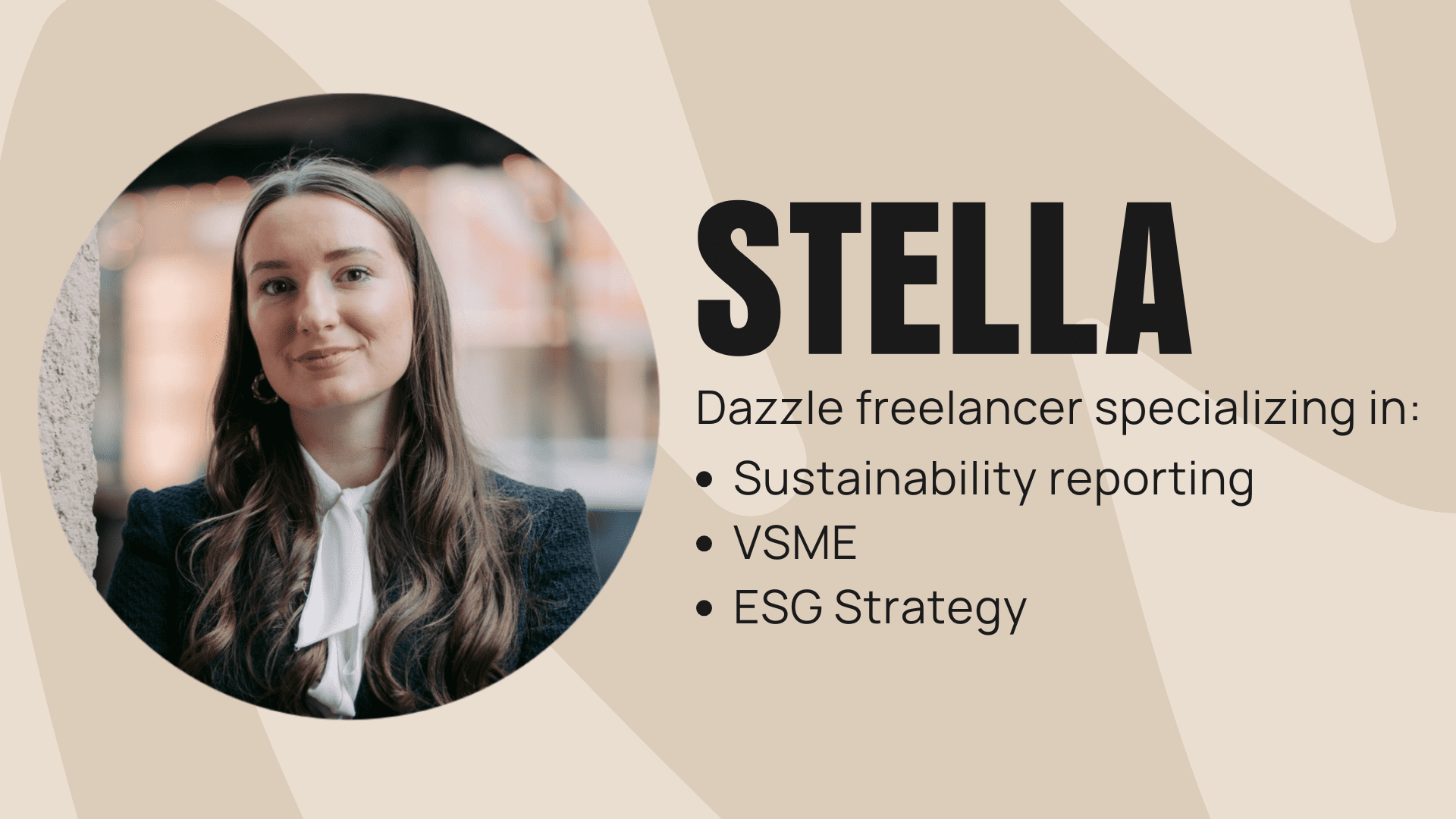
For a CSRD reporting review, a freelance sustainability consultant who specializes in CSRD and ESRS is often the more practical choice. Freelance CSRD experts typically bring deep, focused expertise, operate more efficiently, and cost less than a large consultancy firm. That said, the right answer depends on your organization’s size, internal capacity, and what you need from the review.
Here is how the two options compare in practice:
Freelance CSRD consultants
A freelance expert who specializes in CSRD reporting brings hands-on, current knowledge of the regulation and the ESRS. Because they work independently, they tend to be more agile and available to begin quickly, and they are also typically more cost-effective than large firms — which is particularly relevant if you are commissioning a review rather than a full multi-year engagement. The key is ensuring that the consultant you engage genuinely specializes in CSRD and sustainability reporting, not simply sustainability in general, since this is a specific, technical discipline where generalist experience is widely regarded as insufficient.
Consultancy firms
Larger consultancy firms can deploy broader teams and may be better suited to very large, complex organizations where the review needs to span multiple business units simultaneously. They often have established methodologies and can provide more formal deliverables. The trade-off is cost, speed, and sometimes a degree of internal process that slows progress when you need to move efficiently.
For most organizations looking to begin with a CSRD review, the freelance route offers a strong combination of specialized knowledge, flexibility, and speed. What matters most is that whoever you engage has direct, current experience with CSRD compliance and the revised ESRS — not simply general sustainability credentials — given how substantially the regulatory landscape shifted in 2026. If you are ready to take that next step, here is how to get started.
Ready to get your CSRD review started?
Getting clarity on your current reporting setup does not have to be a slow or complicated process. At Dazzle, we match organizations with pre-screened CSRD consultants who specialize in exactly this kind of work. Whether you need a focused gap analysis or a more comprehensive review, we can connect you with the right expert for your situation, often within 48 hours.
Our network includes sustainability specialists across CSRD, EU Taxonomy, and other reporting frameworks, so you are matched based on your specific challenge rather than whoever happens to be available. If you are ready to find out where you actually stand before committing to a full compliance project, get in touch with our team and we will take it from there.
Working on your CSRD report?
The free CSRD Evidence Register lists all 14 documents, what each costs you and where teams get stuck, from a panel with Dazzle clients PostNL and Samskip.